News & Events
Newly launched Unisa centre to strengthen TVET beyond Africa
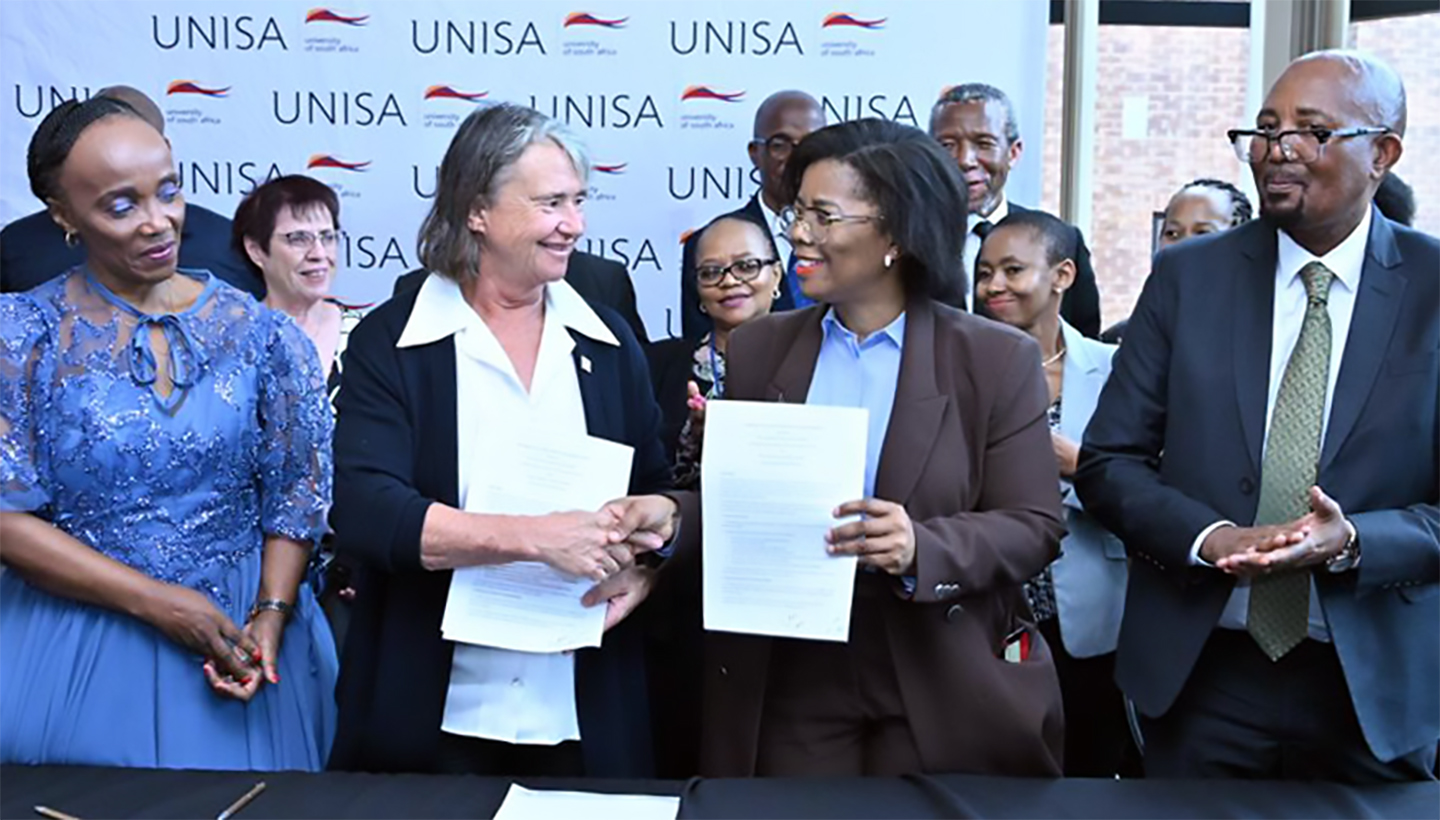
At the MoU signing, from left: The Honourable Sindisiwe Chikunga, Minister of Women, Youth and Persons with Disabilities, Dr Anna Marais, Associate Dean of the School of Veterinary Medicine, UNAM, Prof Puleng LenkaBula, Unisa Principal and Vice-Chancellor, and Dr Nkosinathi Sishi, Director-General: Department of Higher Education and Training
On 23 March 2026, Unisa hosted an official inauguration ceremony at its Science Campus in Florida, Johannesburg, to unveil the UNESCO International Centre for Technical and Vocational Education and Training (UNEVOC). This marks a significant milestone in advancing technical and vocational education and training (TVET), both locally and globally.
The newly established centre is set to become a hub for knowledge exchange, research, and innovation in skills development. It will play a critical role in shaping responsive education systems that address national priorities while aligning with global workforce demands. Delegates and stakeholders were introduced to the centre’s strategic direction, its role within the UNEVOC Network, and its contribution to strengthening South Africa’s broader TVET sector.
The prestigious event brought together a distinguished audience, including representatives from national, provincial and local government, senior executives from the Department of Higher Education and Training (DHET), members of the diplomatic corps, international partners, ambassadors, and representatives from UNESCO and the UNEVOC headquarters in Bonn, Germany. Professor Mamokgethi Phakeng, former Vice-Chancellor of the University of Cape Town, also attended and was acknowledged for her contributions during her tenure as Unisa’s Vice-Principal of Research and Innovation.
Representatives from the Association of Technical Universities and Polytechnics in Africa (ATUPA), the Education, Training and Development Practices Sector Education and Training Authority (ETDP SETA), academia, the TVET sector, and industry were also in attendance, as were students from across the country.
Future-focused vision committed to global partnership
Delivering her welcome remarks, Professor Puleng LenkaBula, Unisa Principal and Vice-Chancellor (VC), said the launch represents more than an institutional milestone; it signals a commitment to shaping a future in which education is inclusive, innovative, and responsive to the demands of a rapidly evolving world of work.
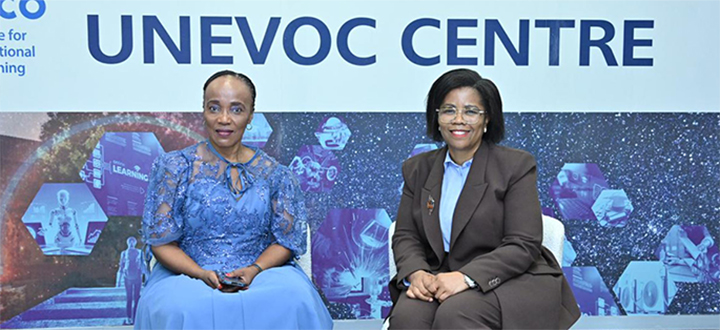
From left: The Honourable Sindisiwe Chikunga, Minister of Women, Youth and Persons with Disabilities, and Professor Puleng LenkaBula, Unisa Principal and Vice-Chancellor
The VC emphasised the critical role of TVET colleges in driving economic development across the continent. “They are vital for bridging the skills gap and directly addressing high youth unemployment by offering practical, industry-aligned training,” she said. “This creates faster specialised career pathways in sectors such as engineering and IT, enhances employability, fosters entrepreneurship, and accelerates economic growth.”
She added that TVET institutions are essential for producing artisans and technicians through practical, industry-specific training, in response to Africa’s urgent need to adapt to technological advancements shaping education, work, and everyday life in the 21st century.
The VC further highlighted that, as a comprehensive open, distance and eLearning (CODeL) institution, Unisa is mandated by the DHET to deliver a range of qualifications, including generic, professional, vocational, and occupational programmes. She expressed appreciation to UNESCO and the UNEVOC International Centre for the confidence placed in the university.
“The university has committed to fulfilling its role as a UNEVOC Centre with dedication, innovation and accountability,” she said, noting that the partnership strengthens South Africa’s position in the global education landscape while contributing to continental development goals.
Addressing Africa’s skills gap and transformation
In her keynote address, the Honourable Sindisiwe Chikunga, Minister of Women, Youth and Persons with Disabilities, underscored the significance of Unisa’s admission into the UNEVOC Network as a milestone for both South Africa and the African continent.
She highlighted Unisa’s longstanding role in expanding access to education for working-class and rural communities, positioning the institution as a key driver of inclusive development and social transformation.
Chikunga emphasised the urgency of responding to a rapidly evolving global labour market shaped by digitalisation, green economies, and innovation. She called for strengthened investment in TVET to equip young people with relevant skills for both employment and entrepreneurship.
She further stressed the importance of aligning TVET with continental priorities such as Agenda 2063, while advocating for inclusive education systems. In particular, she called for the meaningful inclusion of young people with disabilities in skills development initiatives, noting that inclusion must be practical and not merely a policy formality.
In his address, Dr Nkosinathi Sishi, Director-General of the Department of Higher Education and Training, positioned the initiative within the broader vision of a national skills revolution. He emphasised the importance of inclusive global partnerships across government, industry, academia, diplomatic missions, and international collaborators to strengthen the TVET ecosystem.
Sishi also situated the centre within the framework of the UNESCO TVET Strategy (2022–2029), which positions TVET as a catalyst for economic development, social justice, and sustainable livelihoods. He stressed that education must go beyond technical skills, fostering well-rounded individuals capable of responsible citizenship in a rapidly evolving global economy shaped by digital transformation and sustainability imperatives.
He highlighted key national initiatives, including the forthcoming Human Resource Development Strategy, the “one country, one plan” Master Skills Plan, and the Just Energy Transition Skills Desk, as efforts to build a more coherent and demand-responsive skills system. He also pointed to ongoing curriculum reforms in TVET colleges, particularly the shift towards occupational programmes, as critical to improving relevance and quality.
Olivier Pieume, Chief of the Technical Cooperation Unit at UNEVOC, emphasised that the UNEVOC Network serves as a global platform for collaboration, capacity building and knowledge sharing across more than 150 countries. He noted that the network supports member states through research, policy dialogue and partnerships across both public and private sectors.
Head of UNEVOC, Friedrich Huebler, delivered his remarks virtually, describing the initiative as not only a recognition of past achievements but a renewed commitment to building inclusive, innovative and responsive skills systems. He commended Unisa for expanding access to education and advancing lifelong learning in line with UNESCO’s principle of leaving no learner behind.
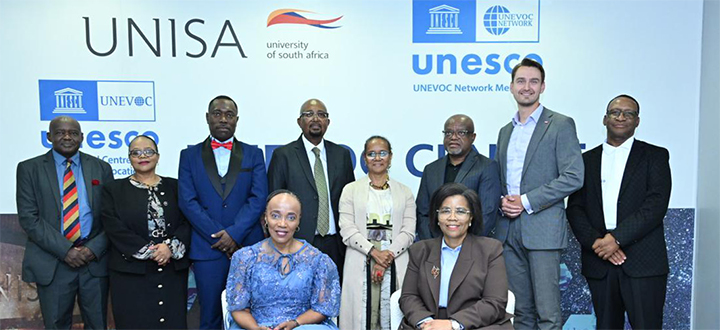
Front, from left: The Honourable Sindisiwe Chikunga, Minister of Women, Youth and Persons with Disabilities, and Prof Puleng LenkaBula, Unisa Principal and Vice-Chancellor Back, from left: Dr Azwinndini Tshivhase, Acting VP: Teaching, Learning, Community Engagement and Student Support, Unisa, Dr Matseliso Molapo, Acting VP: Strategy, Risk and Advisory Services, Unisa, Olivier Pieume, Chief of the Technical Cooperation Unit at UNEVOC, Dr Nkosinathi Sishi, Director-General: Department of Higher Education and Training, Prof Sello Mokoena, Local Organising Committee Chair, and distinguished delegates
The ceremony also introduced Unisa’s designated UNEVOC team. A key highlight was the signing of a memorandum of understanding (MoU) between Unisa and the University of Namibia (UNAM) to advance collaboration in veterinary education, research, and training, specifically within the framework of Unisa’s College of Agriculture and Environmental Sciences.
Click here to watch a recording of the ceremony.
* By Lesego Chiloane, Journalist, Department of Institutional Advancement
** Photography by Shooheima Champion, Multimedia Centre
Publish date: 2026-03-24 00:00:00.0