

Towards the leading College of Law and Justice in Africa

The Ivorian delegation together with the Executive Dean, Prof Mfari-Budeli-Nemakonde
The University of South Africa's (Unisa) College of Law successfully hosted its 11th Annual Law Conference on 23 April 2026 at the Senate Hall, bringing together distinguished academics, members of the judiciary, legal practitioners, policymakers, criminal justice professionals, students, and international delegates.
The conference was officially opened by the Executive Dean of the College of Law, who welcomed guests, including former President and Chancellor Dr Thabo Mbeki, Unisa Principal and Vice-Chancellor Professor Puleng Lenka-Bula in absentia, members of the university executive, Justice Molemela, international delegates from Côte d'Ivoire, and the Minister of Justice of Eritrea, Madam Fazia Hashem, who joined virtually.
A platform for critical engagement
Held under the theme, "Reimagining Justice, Ethics and Governance in Africa in a Digitally Borderless World: Perspectives for a Transformative Future," the conference provided a platform for critical engagement on the impact of digital transformation, artificial intelligence, and global interconnectedness on justice systems across Africa and beyond.
The Executive Dean highlighted the importance of ensuring that technological advancements in the legal sector promote ethical, inclusive, and transformative justice that responds to African realities and developmental needs. Discussions centred on how legal systems can embrace innovation while remaining firmly grounded in constitutional values, human dignity, fairness, accountability, and social justice.
The conference further aligned with Unisa's vision of shaping futures in the service of humanity and supported the institution's strategic focus on digitalisation, the Fourth Industrial Revolution, and interdisciplinary research. Participants explored African-centred approaches to governance and ethics, while examining the evolving role of law and criminal justice in an increasingly interconnected world.
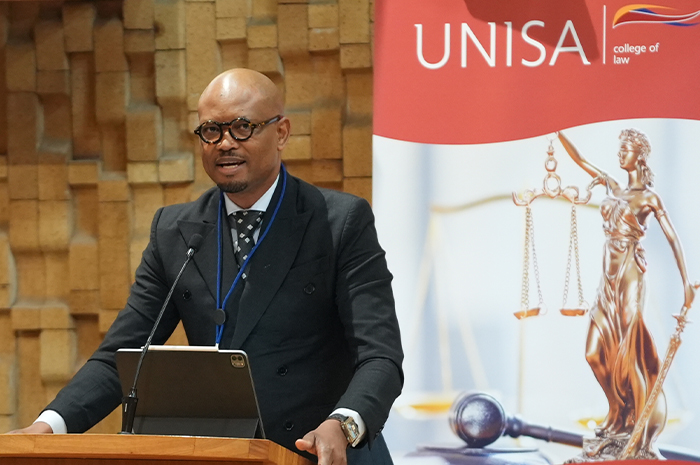
Adv Motebang Ramaili SC
A key feature of the conference was the diversity of perspectives represented, with judges, legal practitioners, academics, students, policymakers, and civil society organisations contributing to meaningful dialogue and knowledge exchange. The gathering reinforced the importance of collaboration and interdisciplinary engagement in addressing contemporary legal challenges.
The conference also highlighted Unisa's ongoing commitment to advancing the Sustainable Development Goals through quality education, gender equality, peace, justice, and strong institutions. Particular emphasis was placed on empowering the next generation of legal professionals and scholars who will shape the future of justice in Africa.
African voice
A notable contribution to the conference was a presentation by the National Gendarmerie of Côte d'Ivoire on "Cybersecurity and Judicial Policing in the Face of the Transformation of Technological Crime." The presentation explored the growing impact of cybercrime on national security, governance, and the administration of justice in Africa.
The delegation highlighted cybersecurity as a matter of national sovereignty, emphasizing the need to protect critical infrastructure, public data, and state institutions from increasingly sophisticated cyber threats. Particular attention was given to the evolving nature of criminal activity, where perpetrators operate across borders, evidence is often digital and transient, and traditional investigative approaches are challenged by rapidly advancing technologies.
The presentation examined Côte d'Ivoire's legal framework for combating cybercrime, noting progress made through cybercrime legislation while identifying emerging challenges relating to artificial intelligence, cryptocurrency regulation, cross-border investigations, and international judicial cooperation. Practical case studies, including cyber incidents affecting critical infrastructure and the successful Interpol-led Operation Red Card 2.0, demonstrated the scale and complexity of cybercrime across the African continent.
Delegates further explored the operational challenges faced by law enforcement agencies, including the preservation of digital evidence, jurisdictional complexities, technical investigative requirements, and the speed at which cybercrime evolves. The growing threat posed by artificial intelligence-driven crimes, such as deepfakes, automated phishing campaigns, adaptive malware, and AI-enabled social engineering, was identified as a significant concern requiring urgent legislative and operational responses.
The presentation concluded with recommendations aimed at strengthening Africa's cybersecurity capabilities, including specialised cyber-investigation training, investment in digital forensic technologies, enhanced regional and international cooperation, legal reform, and the promotion of a cybersecurity culture across law enforcement institutions. These insights aligned closely with the conference theme of reimagining justice, ethics, and governance in a digitally borderless world and contributed valuable perspectives on safeguarding justice systems in the digital age.
Another insightful presentation focused on the Influence of Artificial Intelligence in the South African Legal System, presented by Adv Motebang Ramaili SC, examined the opportunities, challenges, and responsibilities associated with the increasing use of AI in legal practice and judicial processes.
Adv Ramaili SC highlighted how artificial intelligence is already transforming legal systems worldwide and is increasingly influencing the South African legal landscape. AI technologies are being utilised in legal research, case analysis, document drafting, litigation support, and judicial administration, enabling practitioners to analyse large volumes of information more efficiently, reduce costs, and improve access to legal services.
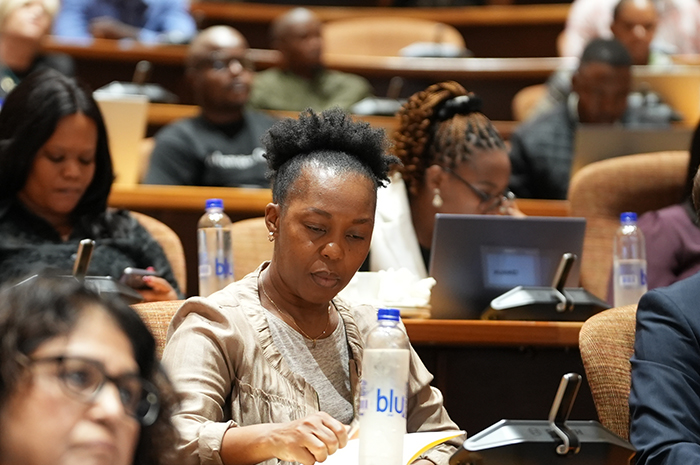
Some of the delegates at the 11th Annual Law conference
The presentation explored the growing role of AI in legal research and document preparation, noting that while these technologies can significantly improve efficiency and standardisation, they also present risks such as inaccurate information and fabricated legal citations. Reference was made to South African court cases that have highlighted both the potential benefits and dangers of AI-generated legal content, reinforcing the need for human oversight and professional accountability.
A key theme of the discussion was the contribution of AI to improving access to justice. AI-powered tools can assist members of the public with basic legal guidance, simplify complex legal language, and support self-represented litigants, thereby expanding access to legal information and services for underserved communities.
Ethical and legal challenges of AI
The presentation also examined the ethical and legal challenges associated with AI, including concerns relating to accuracy, reliability, confidentiality, data protection, bias, and fairness. Particular emphasis was placed on the responsibility of legal practitioners to verify AI-generated work and to ensure compliance with existing legal and ethical obligations.
Delegates were further informed about South Africa's evolving regulatory environment, including proposed initiatives aimed at establishing governance structures for the ethical development and use of artificial intelligence. These developments seek to balance innovation with the protection of constitutional values such as dignity, equality, fairness, and accountability.
The session concluded that while AI has the potential to transform the legal profession through greater efficiency, affordability, and innovation, it cannot replace human judgment, ethical reasoning, or professional responsibility. Rather, the future of the legal system will depend on effective collaboration between technology and legal professionals to ensure that justice remains accurate, transparent, and accountable in an increasingly digital world.
*By Ngwako Mokgotho, Communications and Marketing Specialist, College of Law
Publish date: 2026-06-12 00:00:00.0
 From Unisa graduate to global fraud intelligence investigator
 Studying at Unisa was the right decision
 More than a game: Unisa is building health, teamwork and lasting connections through sport
 How prominent researcher is changing lives and raising Unisa's global profile
 Literary scholar earns an NRF Y2 rating