

Equipped with state-of-the-art laboratories that provide students with hands-on experiences to bridge theory and practice
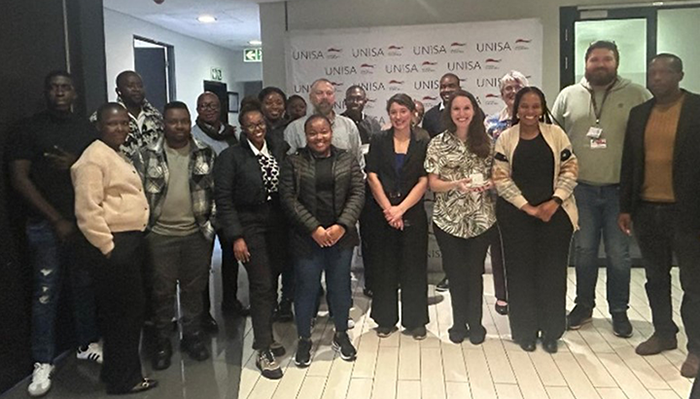
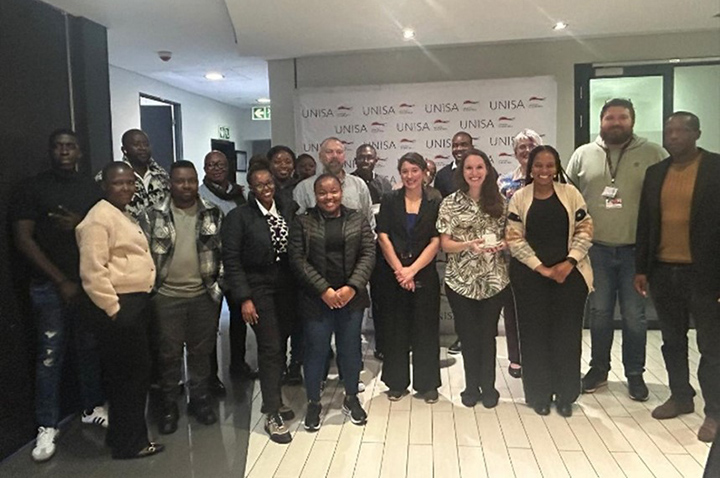
Dr Melis Cin, Prof Ashley Gunter and Dr Leani van Vuuren with the Next-Gen Partnerships research team
As African researchers in a global setting, Unisa's academics are constantly engaging with partners in the Global North. While these collaborations are central to international funding and research, there has been far less attention on how international partnerships are built, sustained and experienced in practice. Researchers at Unisa, Kenyatta University, the Johannesburg Holocaust and Genocide Centre, the Open University UK, Lancaster University and Aberdeen University are helping to address this gap.
Led by Dr Leani van Vuuren and Prof Ashley Gunter from the Department of Geography in the College of Agriculture and Environmental Sciences (CAES), the studies have investigated the evolving discourse on equitable partnerships between researchers in the Global North and Global South. Their work responds to growing recognition that these partnerships should be equitable. Over the past two years, this work has been advanced through two collaborative research projects.
The first project, Building Equitable African Partnerships (BEAP) (2024 – 2025), was funded by the Arts and Humanities Research Council (UK). It brought together researchers and civil society organisations from across Africa to explore how researchers in the Global North and South engage. It also explored the power dynamics between researchers and communities, as well as funders and universities.
Building on the BEAP project, the Next-Gen Partnerships: Advocacy and Sensitisation of Equitable Research Collaboration Principles to New Actors project was funded by the British Academy (2025 – 2026). This project tested the principles of partnership developed in the BEAP Africa Report and other internationally recognised frameworks by applying them to three new Africa–UK research partnerships. The project explored the lived experiences of researchers at the University of Venda, the University of Fort Hare, and partners in the UK to better understand how equitable collaboration can be implemented in practice.
These projects have resulted in a number of practical resources to support the research sector in developing stronger, more equitable collaborations. The resources were launched in March 2026 and are freely available to the international research community through the links below.
These projects demonstrate Unisa's growing contribution to international debates on equitable research partnerships. By combining African leadership with long-standing international collaboration, the research is helping to shape a new generation of partnerships that place reciprocity, shared leadership and mutual benefit at the centre of global research.
* By Dr Leani van Vuuren and Prof Ashley Gunter, both of the Department of Geography, College of Agriculture and Environmental Sciences
Publish date: 2026-07-16 00:00:00.0
 Breaking barriers through RPL
 Why Generation Z is choosing Unisa for flexible learning
 The long run to leadership: an MBL graduate's story of grit and achievement
 Building the future of an equitable Africa
 The hallmark of academic and professional excellence