

The African college of excellence in the social and human sciences
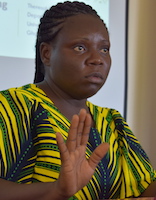
Dr Theresa Ennin
In her presentation delivered at a Unisa College of Human Sciences’ research seminar, Dr Theresa Ennin spoke on Breaking Gods by interrogation of African feminist literature. During her research, she found the notion of “masculinity” quite fascinating, and realized it was also quite new and under featured in African literary studies. In that light, she felt compelled to study gender masculinities looking at text and film.
Dr Ennin said that inherent in African feminism, and more often overlooked or missed, is the idea that the objective is not only to liberate the female African but also to develop the African male, a characteristic that uniquely differentiate African feminism from that of the west.
With reference to Stephan F Miescher’s Making Men in Ghana, she spoke of the “big man” status and said it is described as one who commands respect and service of people he considers less than him. This status is validated by various markers like having massive livestock, many wives and children, servants and property.
With that in mind, Dr Ennin analysed two novels, Beyond the Horizon and Changes, and investigated the way male characters in the novels are trying so hard to achieve the ideal of the big man, a hegemonic masculine ideal, which she believes in the current modern Ghanaian society is not relevant anymore. She said that there were amplified newer models of the big man status that have emerged. Factors in the reimaging of the big man are, among others, education; providing access to non-traditional careers and wealth; the reliance of traditional definitions of manhood becoming irrelevant; women becoming financially independent and gaining the power to make decisions and choices for themselves; and travelling.
In Changes, Dr Ennin looked at issues of masculinities arising in three marriages where husbands struggle to maintain the status of the big man because they feel emasculated by their wives and therefore cannot feed their egos. And in Beyond the Horizon, she examined the story of a man who insisted on living in the city, and later finding out that the city life is too expensive, so he resorted to exploiting his wife, by making her into a sex worker. According to Dr Ennin the question of complicity should be addressed in these texts. She thinks that an African feminist would have to look at the behaviors of women in fueling that of their men.
Dr Ennin concluded by highlighting that the anxieties and pressures seen on male characters in the texts, as they strive to achieve hegemonic ideals, is something that should be rechecked. She recommended that a new identity of masculinity is needed, a masculine identity that will coexist with liberatory feminine identities peacefully without any anxiety. Behavior that will take into account the importance of both genders such that characters in African fiction would reflect the demands of progressive thoughts. She said it is pertinent to note that changes in masculinities takes place in society that is continually changing and reinventing itself.
Dr Ennin’s idea of the African feminist, is one who believes in change within the African man, change that can overturn the toxic narratives and harmful practices to both women and men.
* By Katlego Pilane (CHS Communication and Marketing)
Publish date: 2019-02-18 00:00:00.0
 Scaling success: Unisa reflects on leadership, academic excellence and growth
 Unisa welcomes students during Orientation Week 2026
 Unisa hosts the Zimbabwe Open University to exchange research know-how
 Towards a ritual-informed humanitarian psychology
 Unisan joins the Executive Committee of CSA-SA