

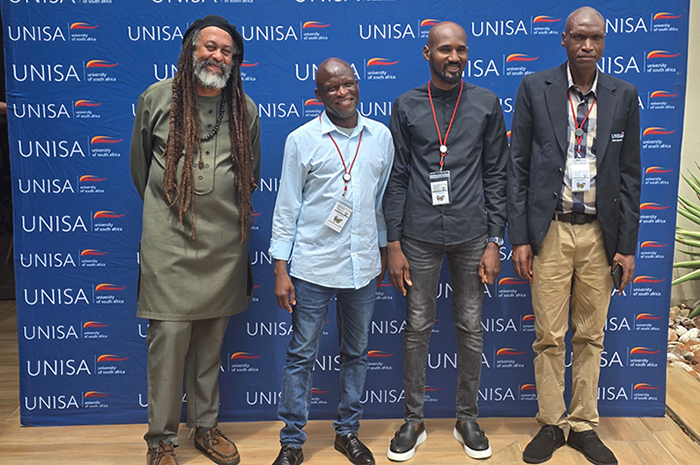
From left: Advocate Sipho Mantula, Michael Monyela, Tiyiselani Maluleke and Master Maebane
Unisa’s ongoing work in research, youth engagement, and community partnerships to address social and economic challenges was part of what the Unisa team shared with participants at the recent annual Limpopo Research Forum Conference, held in Lephalale.
The event was attended by representatives of government, institutions of higher learning, state-owned entities, civil society and other interest groups. It is a collaboration between the Office of the Premier, the South African Association of Public Administration and Management (SAAPAM), Stats SA, Unisa, Tshwane University of Technology (TUT), the University of Venda (Univen) and the University of Limpopo (UL).
The focus was on how to use research to promote governance and growth, hence the theme: "Governance, Growth, and Geopolitics in the Digital Age: Strengthening State Capacity and Economic Resilience through Technological Transformation".
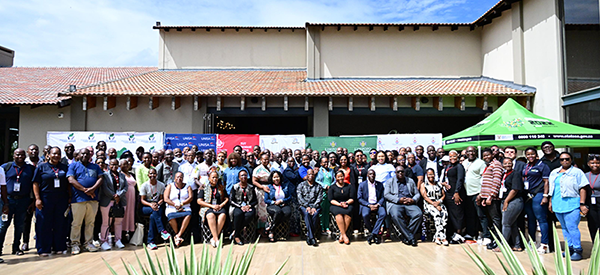
Attendees at the conference
Delivering his keynote address, Advocate Sipho Mantula, a researcher at Unisa’s Thabo Mbeki African School of Public and International Affairs, opened with his usual salutations of using multiple African languages before paying tribute to Limpopo’s traditional leaders and ancestors, setting a tone grounded in respect and unity.
The title of his presentation was "Shaping the Future of Afrikan Governance, Growth and Geopolitics in the Age of Natural Resource and Human Security System: Limpopo, South Afrika and Afrika at the Crossroads".
Mantula reminded participants that effective governance and sustainable development must draw from Africa’s rich heritage while embracing the realities of rapid technological change. "Africa can only be truly free if it breaks away from the epistemic dominance of the West," he stated.
His address challenged universities and research bodies to move beyond inherited colonial frameworks. Citing scholars such as Ngũgĩ wa Thiong’o and Prof Toyin Falola, he called for integrating indigenous knowledge systems with modern scientific methods.
"Our research must serve the people, motivate emerging scholars and expand networks for evidence-based development," said Mantula
The conference theme was brought to life as Mantula explored how the Fourth Industrial Revolution (4IR) is reshaping governance and economic resilience. He highlighted both the promise and peril of digital transformation, urging policymakers to bridge internet access gaps, harness technology for the public good, and counter the risks of misinformation. "Digital innovation must be coupled with ethical, indigenous values to ensure Africa is not left behind," said Mantula
According to Mantula, as a gateway to various countries in the Southern African region, Limpopo plays a unique role in cross-border trade, tourism and regional integration. He called for urgent investment in infrastructure, water, sanitation, electricity and broadband to unlock the province’s full potential and benefit all communities.
He stressed the need for education that nurtures critical and creative thinkers, "not just accumulators of facts".
About South Africa preparing to chair the SADC Council of Ministers, Mantula urged delegates to align provincial, national and continental agendas for greater impact. "Collaboration, rooted in African knowledge and digital transformation, is key to building a resilient and just society," he concluded.
Other Unisa team members presented papers (individually or co-presenting with participants from other universities) on the following topics:
In addition to presentations, some Unisa team members facilitated sessions, whilst others were members of the organising committee and its subgroups.
* By Matsobane Madisha, Digital Learning Advisor, North Eastern Region
Publish date: 2026-05-04 00:00:00.0
 From Unisa graduate to global fraud intelligence investigator
 Studying at Unisa was the right decision
 More than a game: Unisa is building health, teamwork and lasting connections through sport
 How prominent researcher is changing lives and raising Unisa's global profile
 Literary scholar earns an NRF Y2 rating