
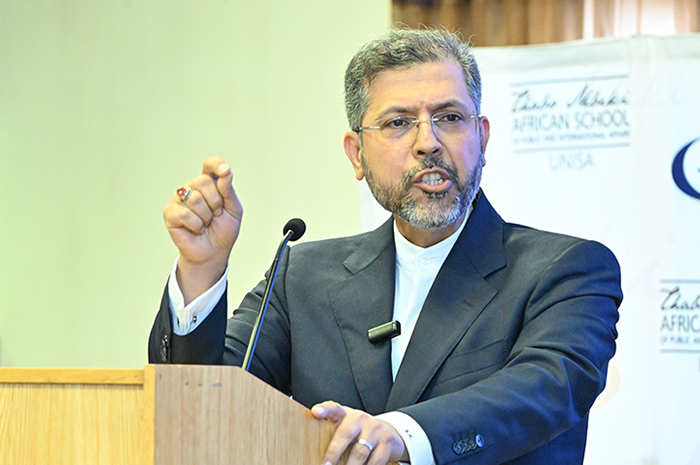
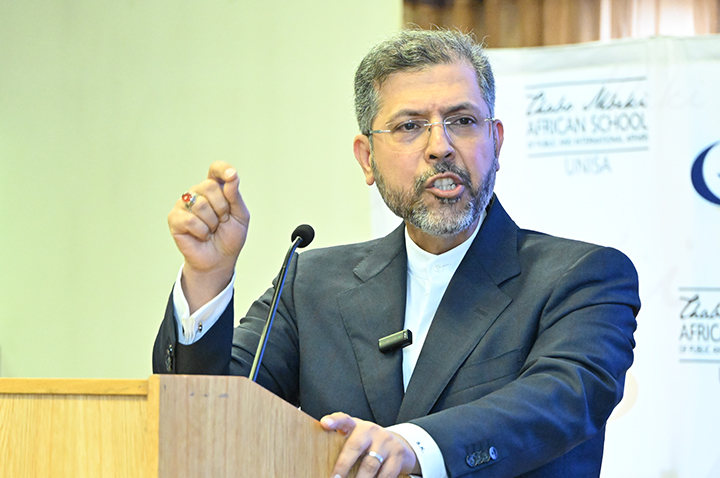
Dr Saeed Khatibzadeh, the Deputy Foreign Minister of Iran, addressing the audience
The Thabo Mbeki African School of Public and International Affairs (TM-School) and the Department of Institutional Advancement recently hosted a Diplomatic Seminar, during which the Deputy Foreign Minister of the Islamic Republic of Iran served as the guest speaker.
The seminar was timely because of the current negotiations between the Islamic Republic of Iran, on one hand, and the United States of America and Israel, on the other. This high-level engagement delivered on its promise, providing participants with firsthand insight into how Iran understands the conflict and its future resolution. Khatibzadeh did not mince his words when he argued that the world is undergoing a geopolitical transformation due to the war.
The conflict began on 28 February 2026, when US and Israeli forces launched coordinated surprise airstrikes and major combat operations against Iran’s military infrastructure, nuclear facilities and leadership. The opening salvo included US Operation Epic Fury and Israeli Operation Roaring Lion, which targeted sites in and around Tehran, Isfahan and other strategic locations. The ceasefire took effect on 8 April 2026, and we are now witnessing the peace negotiations with Iran seemingly the victor.
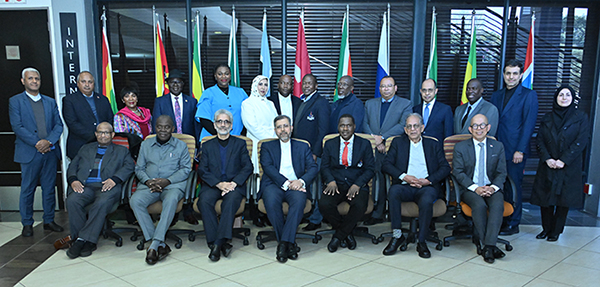
Members of the diplomatic corps and Unisa staff members
Given the high-level diplomatic engagement, the seminar was intellectually vibrant. The seminar was opened by David Letsoalo of the TM-School of Public and International Affairs, followed by South Africa’s former ambassador to Iran, Ibrahim Saley, who focused on the history and bilateral relations between Iran and South Africa.
The introductions set the stage for the main presentation by Khatibzadeh, who began his address by stating that he would not read the prepared text but would rely on his intimate knowledge as an intellectual, a participant and an official of the Islamic Republic of Iran.
Khatibzadeh began by detailing the events of 28 February 2026, when the USA and Israel assassinated the leader of Iran, Ayatollah Khamenei and his family. He cited this as a violation of Iran's sovereignty. This act of aggression had the Iranians viewing it as an existential war for survival, and it closed any opportunity for diplomatic dialogue.
The Deputy Foreign Minister was at pains to demonstrate the catastrophe of these attacks and that Iran had always relied on dialogue as a diplomatic tool. Moreover, Khatibzadeh emphasised that this war of aggression and domination, as he called it, violated the international rule-based order. Against such obstacles, the Iranian strategic cards were to resist and defend their sovereignty by equally striking at US military bases and at Israel to show the military might and dedication of their forces.
The coalition between the USA and Israel committed crimes of war, according to the Deputy Foreign Minister, when a devastating airstrike destroyed the Shajareh Tayyebeh Elementary School in Minab, Iran. The attack killed over 170 children and teachers, sparking international outrage and investigations.
Why was Iran being attacked? Khatibzadeh argued that firstly, Iran was seen as an aggressor posing an imminent threat to the security of the region, and secondly, that Iran was seeking to build a nuclear weapon, which, according to Tulsi Gabbard, the Director of National Intelligence in the USA, a few months earlier, was not the case. The deputy foreign minister highlighted that Iran was not seeking to build a nuclear weapon; their nuclear programme was always a peaceful project, as attested by the International Atomic Energy Agency.
He outlined how the USA had betrayed them during the two previous diplomatic negotiations as a strategy or mask to strike at Iran in the same way as they did last year with the Twelve Days War and the latest military conflict. The USA uses diplomacy as a cover for violence. He argued that the American doctrine of "peace through strength" was to blame for the war in Iran in the same way as it was with the abduction of the President of Venezuela.
Khatibzadeh concluded by stating that this war has strategically placed Iran as the victor on the battlefield and that the negotiations should reflect this situation. Therefore, the war brought about geopolitical transformations with global impact. This war has changed the region's geopolitics, revealing who is on the USA's side. Iran challenged the unfettered power of the USA and is stopping the expansionist policy of the state of Israel.
He thanked South Africa for its support for the Palestinian struggle against apartheid, just like Iran, which cut ties with apartheid South Africa.
The floor was then opened for questions, and a stimulating and thought-provoking session followed. The Deputy Foreign Minister answered the questions brilliantly. This author asked about the historical analysis of relations between Iran and the USA, and there were questions about the situation in Venezuela, the confusing nuclear programme and Iran’s analysis of Third World anti-imperialism. Khatibzadeh answered with grace but, due to time constraints, could not address all the questions. He indicated that what happened in Venezuela, as well as the strikes on Iran, proved that we were not living in a rule-based but rather a force-based order, and there should be consequences for killing leaders of sovereign nations. He told the participants that Iran had the biggest oil and gas reserves in the world and that the USA tried to get their hands on such but were unsuccessful in their efforts. He showed how important it was to understand history because the current conflict did not begin this year or last year but stretched back much further. He indicated that, as in the latest round of negotiations, Iran had always emphasised the importance of diplomatic dialogue. At the moment, Iran resisted the war of aggression and domination, and this should be a lesson to all countries to respect the rule-based international order.
This seminar was intellectually vibrant for students of politics, international relations, West Asia, Peace and Security Studies and Third World anti-imperialism. Dr Saeed Khatibzadeh is a brilliant speaker who delivered knowledge with insight and foresight.
* By Dr Thabang Manyike, Postdoctoral Fellow, Thabo Mbeki African School of International and Public Affairs
Publish date: 2026-07-14 00:00:00.0
 Second communication science qualification encourages Unisan to go further
 IOP Postdoctoral Fellows build research alliances on the golf course
 Tectonic shifts in geopolitics examined at Unisa seminar
 Unisan makes history as first and youngest Black male Chair of Psychology
 Leading laparoscopic and robotic surgeon to speak at Unisa's CNA Research Symposium